
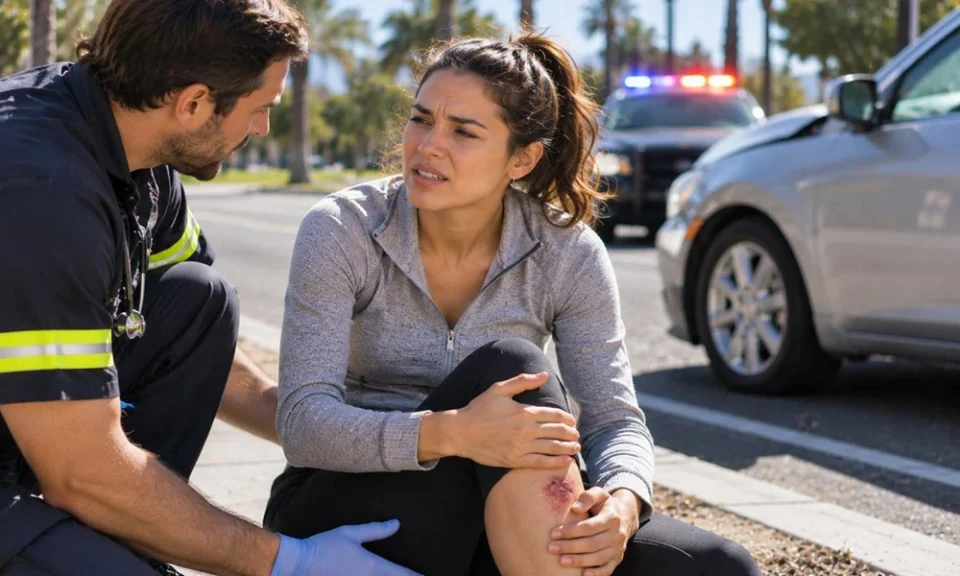
California law requires drivers to yield to pedestrians in marked and unmarked crosswalks and to use due care even when a pedestrian crosses elsewhere. Crossing outside a crosswalk does not automatically kill your claim, because California uses pure comparative fault. Your auto policy may help cover your expenses, even in a hit-and-run. You generally have two years to sue, but only six months to file a claim against a city.
Insurance companies treat pedestrian claims as a blame contest, and they start keeping score the moment you hit the pavement. If you were a pedestrian hit by a car in Riverside, a lawyer specializing in pedestrian accidents in Riverside will tell you the same thing: the adjuster’s first job is to find something you did wrong. Were you on your phone? Were you in the crosswalk? Was the signal still flashing?
Those questions are not about your recovery. They are about shrinking the check.
Here is the truth. California gives pedestrians strong protections. Drivers carry a legal duty of care toward people on foot, and that duty does not disappear because you crossed mid-block or stepped out a second early. The law also punishes careless driving far more than it punishes imperfect walking.
This guide covers the rules that matter, how fault works, where the money comes from, and the deadlines that can end a case early. Knowing your rights is the first way to push back.
Why Pedestrian Claims Start Out Tilted Against You
A pedestrian claim is lopsided from day one. The driver walks away and gives a statement. You may be in an ambulance, sedated, or unable to remember the moments before impact. The insurer gets the first version of the story, and it is rarely yours.
That gap matters in Riverside. The California Office of Traffic Safety’s 2022 rankings counted 91 pedestrians killed or injured in the city that year. Those are not abstract numbers. They are neighbors crossing Magnolia Avenue, University Avenue, Arlington Avenue, and Van Buren Boulevard, plus students and staff walking around UC Riverside and downtown.
Recent headlines show how fast it happens. On July 27, 2026, a Kaiser Permanente Riverside employee was struck and killed in a marked crosswalk at Magnolia Avenue and Park Sierra Drive, according to ABC7’s reporting. Police said the driver had fled an attempted traffic stop and was later arrested on suspicion of murder and felony hit-and-run.
Most crashes are less extreme, but the pattern holds. The person on foot absorbs the impact, while the driver has the advantage.
What California Law Says About Pedestrian Right of Way
Drivers in California must yield to pedestrians crossing in any marked crosswalk or unmarked crosswalk at an intersection. Drivers approaching a crosswalk must slow down or take other action to keep pedestrians safe. Pedestrians must use due care too, but their duty never cancels the driver’s.
That rule comes from Vehicle Code 21950. An “unmarked crosswalk” is simply the natural extension of the sidewalk across an intersection, even with no painted lines.
The same section sets a pedestrian duty. You can’t suddenly leave the curb and walk into the path of a car that is so close it is an immediate hazard. That is a narrow rule about darting out, not a blanket excuse for drivers who were speeding or distracted.
What about crossing outside a crosswalk? Under Vehicle Code 21954, a pedestrian crossing elsewhere must yield to vehicles close enough to be a hazard. But the statute also says the driver still must exercise due care for anyone in the roadway. In plain English: a driver who sees you mid-block can’t just keep going.
Signals matter too. Vehicle Code 21456 explains what “walk” and the flashing hand mean, and a pedestrian who starts on “walk” may finish crossing. Drivers stopping for a crosswalk at a stop sign must stop at the limit line or before the crosswalk under Vehicle Code 22450.
Jaywalking Doesn’t Erase Your Riverside Pedestrian Accident Claim
Crossing mid-block or against a signal does not automatically bar a claim for a pedestrian accident in Riverside. California uses pure comparative fault, so your compensation is reduced by your share of blame, not wiped out. Even a pedestrian found partly at fault can still recover from a careless driver.
Comparative fault means a judge or jury assigns each person a percentage of responsibility. If a judge or jury finds you 20 percent at fault, they will reduce your damages by 20 percent.
The law around jaywalking also changed. The Freedom to Walk Act, AB 2147, took effect January 1, 2023. According to a City of San Diego police training bulletin, officers can no longer stop pedestrians for most crossing violations unless a reasonably careful person would realize there was an immediate danger of collision.
That law is not a free pass, and pedestrians still owe due care. But it undercuts the lazy argument that crossing outside the lines makes you automatically guilty.
The adjuster wants to argue about where you crossed. California law cares more about how the driver drove than about where they crossed.
Another newer law helps. California’s daylighting law, AB 413, bans stopping or parking within 20 feet of the approach side of a crosswalk (15 feet with a curb extension), as the City of Pomona explains. It took effect January 1, 2025. If a parked truck blocked a driver’s view of you, that fact may help your case.
Where the Money Comes From After a Pedestrian Hit by Car in Riverside
After a pedestrian is hit by a car in Riverside, compensation usually starts with the at-fault driver’s liability insurance. When that coverage is too small, missing, or the driver fled, your auto policy may step in through uninsured motorist or medical payments coverage, depending on its wording.
This surprises people. Many California policies define the insured person broadly, and some extend coverage to you if a driver strikes you while you are walking. The California Department of Insurance describes medical payments coverage as paying medical costs regardless of fault, and uninsured motorist bodily injury as covering injuries caused by an uninsured at-fault driver. Whether either reaches you on foot depends on your exact policy language, so read it closely or have a lawyer review it.
Hit-and-run cases are where uninsured motorist coverage often matters most. California policies typically require prompt reporting to police and to your insurer, so call both quickly.
Your health insurance may also pay your bills directly. Just know that many health plans, Medi-Cal, and Medicare can assert a lien, meaning a right to be repaid from your settlement. Those liens are often negotiable, and ignoring them can cost you later.
Damages in a pedestrian case can include medical bills, future care, lost wages, reduced earning ability, and pain and suffering. Pedestrians often suffer brain injuries, spinal damage, and multiple fractures. When injuries are life-altering, a catastrophic injury lawyer can help document the full cost of a future you didn’t choose.
Deadlines That Can Quietly End Your Case
Most pedestrian injury lawsuits in California must be filed within two years of the crash. But if a city, county, or state agency shares blame, for example, over a broken signal or a dangerous crosswalk, you usually must file a formal government claim within six months.
The two-year rule comes from Code of Civil Procedure 335.1. It goes fast, and business security video is often recorded over days or weeks.
The government deadline is far tighter. Under Government Code 911.2, personal injury claims against a public entity generally must be presented within six months. Government Code 835 allows claims when public property was in a dangerous condition and the agency created it or knew about it in time to fix it. Faded crosswalks, malfunctioning signals, and missing lighting can all raise this issue.
If a loved one died, California allows certain family members to bring a wrongful death claim. Those cases follow the same general deadlines, with the same six-month trap if a public agency is involved. Our wrongful death lawyer page explains who can file and what damages may be available.
What Changes When You Have a Riverside Pedestrian Accident Lawyer
A Riverside lawyer for pedestrian accidents shifts the fight from your word against the driver’s to evidence against excuses. That means preserving video, tracking down witnesses, reviewing the police report, identifying every insurance policy, and handling liens so you can focus on healing.
The insurer knows the difference between a claimant who is guessing and one who is represented. Representation doesn’t guarantee any outcome. It does mean the adjuster’s favorite tactics, like recorded statements and quick lowball offers, stop working the way they were designed to.
It also means someone checks angles you might miss. Was the driver working for a company? Did the City of Riverside know about a broken signal? Each answer can open a new source of recovery.
Our Riverside personal injury lawyer team works from our Inland Empire office at 3200 E Guasti Road, Suite 100, in Ontario. We serve injured people across the region, and you can learn more on our Inland Empire personal injury lawyer page or browse common questions in our FAQ.
Your Rights on Riverside Streets Are Stronger Than the Adjuster Admits
The insurance company wants your case to be a debate about where you stepped. California law makes it a question of whether the driver used care. Drivers must yield in crosswalks, watch for people outside them, and pay for the harm they cause, even if you share some blame.
Act early. Get medical care, report the crash, save evidence, and watch the six-month clock if a public agency may be involved. Check your own auto policy too.
Been in an accident or hurt on the job? You don’t have to navigate insurance companies alone. Oracle Law Firm fights to get you the compensation, control, and clarity you deserve.
Get a Free Consultation or call 888.597.4099.
Legal disclaimer: This article provides general information about California law and is not legal advice. Every case is different. Reading this page does not create an attorney-client relationship.
Frequently Asked Questions
Can I still recover if I was jaywalking when I was hit in Riverside?
Often, yes. California uses pure comparative fault, so crossing outside a crosswalk may reduce your compensation but usually does not eliminate it. Drivers still must exercise due care for pedestrians in the roadway.
Does my car insurance cover me if I was hit while walking?
It may. Many California auto policies include medical payments or uninsured motorist coverage that can apply to the policyholder struck as a pedestrian, depending on the policy wording. Review your declarations page and policy, or have an attorney check it.
What should I do after a hit-and-run as a pedestrian?
Get medical care and call the police right away so they can make a report. Notify your own insurer promptly, since uninsured motorist claims often require quick reporting. Write down witness names and note any nearby cameras.
How long do I have to file a pedestrian accident claim in California?
Most injury lawsuits must be filed within two years of the crash. If a city or other public agency may share fault, such as for a broken signal, a government claim is usually due within six months.
Who pays my medical bills while my case is pending?
Your health insurance or your auto policy’s medical payments coverage may pay bills as they come in. Health plans, Medi-Cal, and Medicare may later seek repayment from your settlement through a lien. An attorney can often negotiate those liens down.
